
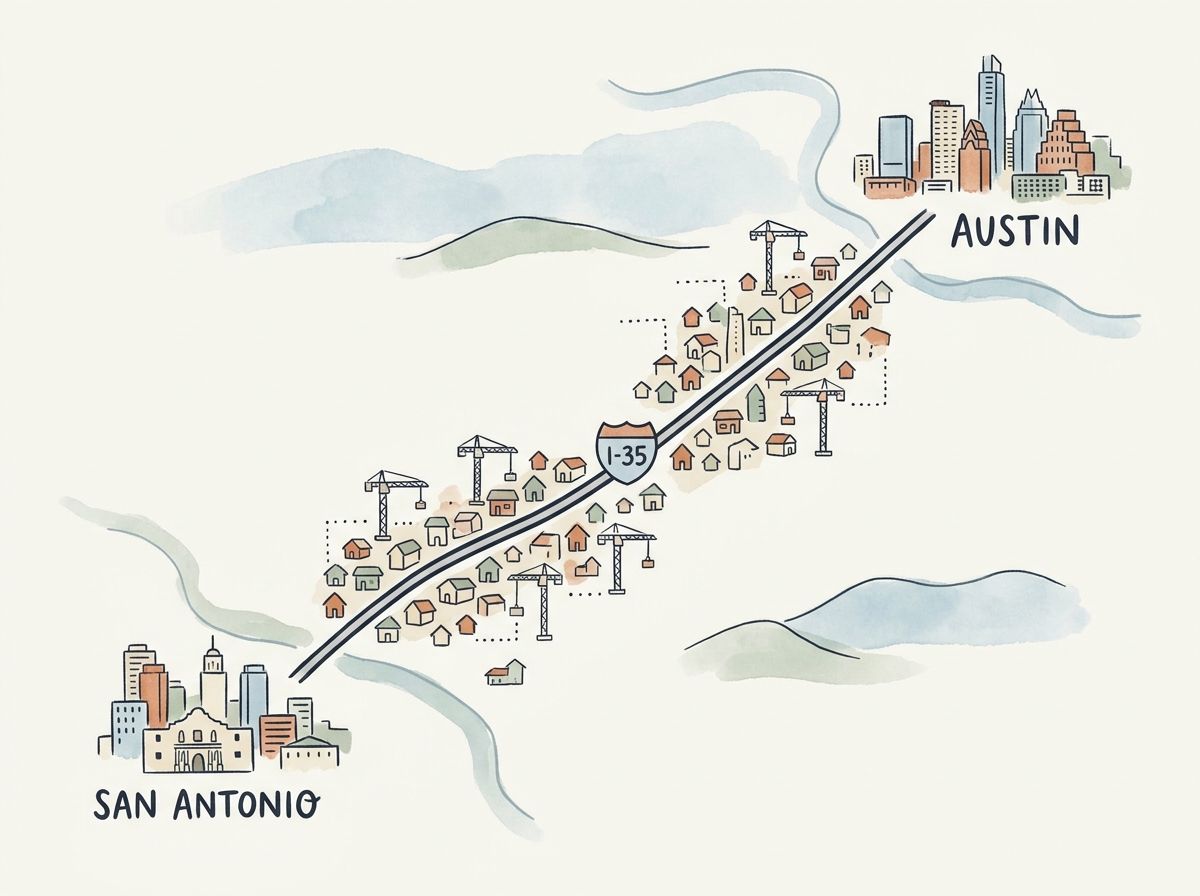
Two Cities, Two Personalities
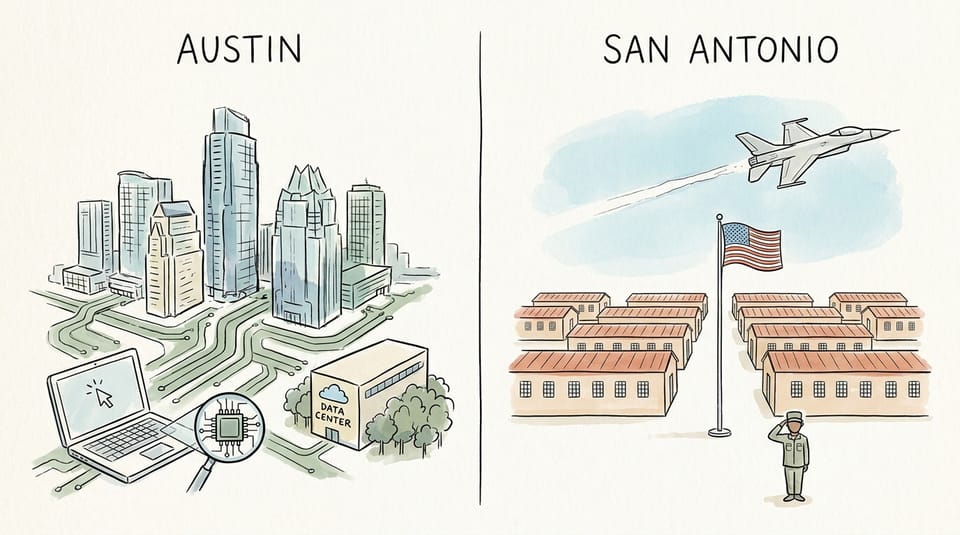
Austin is the tech city. Politically and culturally, it's the blue dot in a red state. Its unofficial motto is "Keep Austin Weird."
San Antonio has a different temperament. It calls itself Military City USA for a reason. Roughly 146,000 veterans live in Bexar County alone, one of the largest concentrations in the country, and Joint Base San Antonio is the largest joint base in the Defense Department. The military has its own disciplined nature, with all the structure and discipline that come with it, and that's part of the city's character.
Put those side by side and you get two very different dispositions sharing one highway. What ties them together is Texas. That Texas spirit runs through both.
How They're Growing Together
The two cities got bigger in different ways. San Antonio grew by taking in more land and annexing it into the city. Austin didn't have much say in the matter. So many people moved in over the last few years that it was forced to grow.
Everybody moves for their own reasons. Tech is a big one in Austin. Companies are investing there and building out larger parts of their business. The cost of living is a lot lower than California, so people relocate, or they set up a second operation.
The AI boom adds to it. Semiconductor investment north of Austin and data center investment up and down the corridor are creating real demand to build between the two cities.
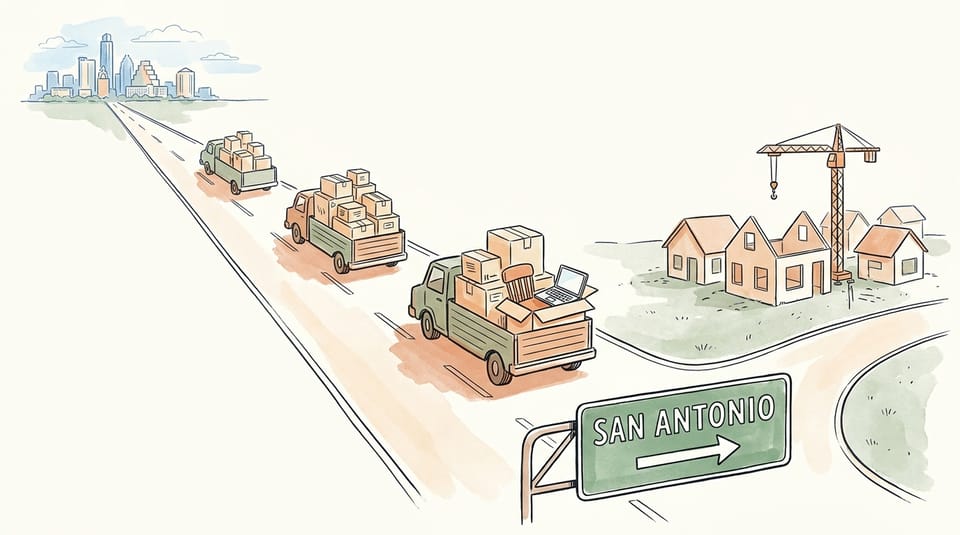
The part I find most interesting is what happens as Austin fills up. The cost of living and the price of land push people and investment south. Keep heading south and you reach San Antonio's metro area, which tends to be cheaper. The commute from one metro to the other keeps getting shorter. That's what's pulling the two together.
The numbers are big. Census Bureau estimates for July 2025 put the Austin-Round Rock-San Marcos metro at 2,620,945 people and the San Antonio-New Braunfels metro at 2,813,140. Counted together, that's roughly 5.4 million. In the year to mid-2025, the two metros added about 92,000 people between them. Henry Cisneros, the former San Antonio mayor, cites a projection of 8.3 million people in the corridor by 2050 in The Austin-San Antonio Megaregion, the book he wrote with Bob Rivard and David Hendricks.
We've seen this happen in Texas before. Dallas and Fort Worth were two separate cities that grew together over time into a larger metroplex.
I think it's going to happen again here. When these two cities finally meet, the economic output between them will be tremendous.
What Comes Next
Traffic will get worse. I won't pretend otherwise.
Texas isn't a state that's big on public transit. There's been talk of a railway or light rail between the two cities, but I think the odds of it happening here are pretty slim. My guess is more freeways, or another tollway like SH 130.
Either way, nobody who lives here gets to avoid the traffic.
Why I Bought In
This growth is one of the reasons we chose to buy the business here. We see where the area is headed, and we see the opportunity in it for us as a company.
Growth brings construction, and construction brings theft. Every truck yard, dealership, warehouse, apartment complex and data center that goes up along this corridor is a property that needs eyes on it after dark, and all of it sits within a 90-minute drive of our monitoring center in San Antonio.
So I bought a home here too. I'm betting on this market, and on being part of this community. When Austin and San Antonio finally meet, I'll already be living right in the middle. My first month as CEO is a story for another article.


